


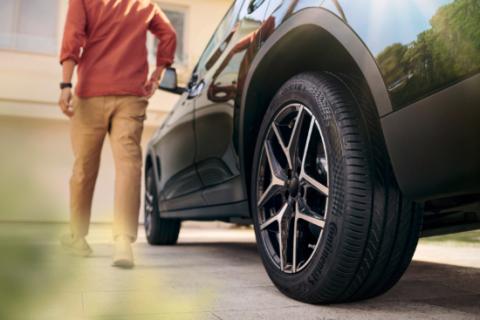
The sole point of contact between your vehicle and the road surface, it’s critical to have a basic understanding of how, why and when to maintain your car’s tyres. It stands to reason, too, that these components should be a high-priority check-list item when purchasing a pre-owned vehicle.
Broadly credited to Scotsman John Boyd Dunlop, the invention of the pneumatic tyre in the late 1880s would prove to be a game-changer in terms of both overall comfort and safety when it came to complementing the evolution of man’s desire to travel further and faster than was previously possible. By 1946, the success of Michelin’s radial tyre construction process paved the way for vehicle manufacturers around the globe to raise the respective bar in terms of what was possible by way of a car’s dynamic ability.
The production process of making a tyre hasn’t evolved too far from the basics of blending various rubber compounds, fillers and ingredients together before constructing a framework from individually milled pieces and then the curing of these components together to form of a tyre of specific proportions and strength. Advances in this industry do however now allow for the fine-tuning of this process to cater for any number of variables when it comes to the requirements of a tyre when fitted to a specific type of vehicle. While some high-performance cars require maximum grip and precision at eye-wateringly high speeds, other more leisure-focussed offerings ask for durability and sidewall strength. As the industry turns its attention to efficiency and improved overall operating range, tyre manufacturers are obliging with lower rolling resistance and optimised noise reduction.
Prior to committing to a vehicle purchase, new or pre-owned, it’s important to consider the implications of what tyres – size, shape and condition – are fitted to that automobile.
On a new purchase it’s always a worthwhile (and, at times, sobering) exercise to research what a replacement tyre might cost, down the line. Indeed, we’ve even heard of brands selling new cars in our market for which it’s near impossible to source a replacement tyre size. Also worthy of consideration is the type of spare tyre specified with the car. While it’s common practice in European markets to forego a spare wheel in favour of run-flat tyre technology, this isn’t always an optimal/safe way to travel in South African conditions.
A bit more homework is required when purchasing a pre-owned car. This includes:
Does the wheel/tyre combination match what was originally specified on the vehicle?
Broadly acknowledged as being a market of car enthusiasts, it’s not uncommon for the owner of a car to seek to “upgrade” the wheel/tyre combination, notably predominantly for cosmetic appeal rather that any actual performance gain. Depending on how far removed from original the result of this modification is, it can alter everything from the gear ratios of the vehicle’s transmission to the odometer and, indeed, indicated speedometer readings. It’s also unlikely that the spare wheel will match the fitted items, both in terms of size and general condition.
Check carefully for uneven wear or, indeed, damage.
While it’s advisable to have all four wheels/tyres on your vehicle rotated every 10 000 km, failure to do this could result in uneven wear all-around and, indeed, shorten the life span of an individual tyre. Regular pavement abuse or pothole encounters can also alter the alignment of the wheels, resulting in uneven wear.Other factors like not ensuring that the specified tyre pressures are being maintained, as well as ignoring listed weight- and speed ratings can cause potentially catastrophic damage to a tyre.
Know your tyre markings
The branding on the sidewall of a tyre offers a wealth of information to those who know what to look for.
Most referred to is the size rating. In an example reading 175/70 R14, the “175” is the width in millimetres of the tyre’s “footprint” on the road, from one sidewall to the other. The “70” is the ratio as a percentage of the sidewall height when compared with the footprint. That said, high-performance low-profile tyres offer a smaller (less flexible) ratio compared with those generally fitted to a passenger car. While the “R” indicates that it is, indeed, a radial compound, the “14” is the size in inches of the wheel that the tyre can/should be fitted to.
Other important sidewall markings indicate the date (week and year) on which the tyre was manufactured, as well as the maximum load- and speed rating of the tyre in question. A ZR rated tyre, for example, is engineered to handle speeds in excess of 240 km/h.
In checking all five (including the spare) tyres on a proposed pre-owned purchase, consider whether the make and sidewall markings (size and ratings) are the same on at least one set, front or rear, of wheels. A mixed bag of compounds, brands or, indeed, sizes could tell a tale of misguided use by a previous owner.
In terms of safety, check that there is a healthy, evenly distributed amount of tread remaining (the legal minimum being 1.6 mm) on each fitted item and that there isn’t any obvious damage to a sidewall, on both the outside and inside of the tyre. While it’s conceivable that a puncture on the rolling surface of the rubber may have been repaired previously, it’s considered unadvisable in terms of the structural integrity of a tyre to repair damage on either a sidewall or thread (where the tyre meets the wheel).
While Aucor offers a comprehensive checklist (and start-up video) on each vehicle that enters a forthcoming lot, it’s nevertheless recommended that a potential bidder attends one of the two earmarked viewing days ahead of the scheduled auction date. This allows the prospective new owner to, quite literally, kick a tyre...
A motoring journalist with more than 20 years’ experience, Ian McLaren will be compiling a series are articles documenting his learning curve when it comes to all things auction. Find him on Twitter, Instagram and TikTok at @IanMcLaren76.
These articles aim to offer insights only and in no way encourage reckless or hit-and-miss purchasing decisions.