


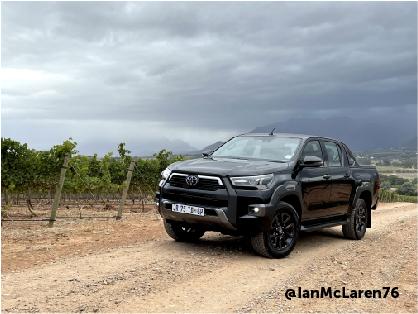
52-years since its introduction, the success of the Toyota Hilux package continues to carve a path across the South African motoring landscape. As popular as ever as a new car prospect, the Hilux is also one the most common sights on both pre-owned forecourts and, indeed, auction house floors. We explore some highlights of this motoring icon.
R1 525; the purchase price of an all-new Toyota Hilux at its local introduction in 1969. Designed at developed by Toyota subsidiary Hino Motors in Tokyo, the arrival of the first-generation Hilux and its 57 kW, 1.5-litre inline four-cylinder engine onto the South African market served as a stark contrast to the Ford F150 alternatives of the time. Despite these relatively modest outputs, the Hilux steadily found favour thanks to its superior levels of perceived build quality, compelling fuel efficiency and a quickly noted reputation for reliability.
Accentuated by the fuel crisis of 1973, the heightened need for maximum efficiency in farming proved an ideal platform on which to elevate the then second-generation Hilux’s popularity compared with its large displacement rivals. By 1975, Toyota sold more than 13 000 units of its 1-tonne, single-cab bakkie on to the South African market. A legend in the making…
A reputation for ruggedness established, the third-generation Hilux introduced two more technological advancement that, to this day, remain key success stories of this nameplate. As of 1978, the Hilux was offered with the choice of a diesel-powered engine and, crucially, with the option of an all-wheel-drive drivetrain.
A firm favourite among the farming community, the move to capture a more lifestyle-focussed, adventure-seeking market came in 1984 with the introduction of a double-cab body style. Capable, reliable and now able to transport a small family, the success of the Hilux package was all-but guaranteed. All this, despite the bakkie’s relatively basic suspension geometry and the non-availability of more powerful engine options offered in other markets. The South African market “made do” with the bulletproof internals associated with the brand’s 2.2-litre diesel motor.
It’s just as well the fourth-generation model proved popular, as Toyota South Africa would be forced to continue marketing this model once it was confirmed our market wasn’t scheduled to receive the fifth-generation version. Consolation came in the form of a locally developed new 2.8-litre turbodiesel engine option.
It wasn’t until 1998 when the sixth-generation Hilux launched in South Africa that local fans were treated to a significantly updated package, complete with independent front suspension and renewed focus on interior comforts. While the farming community remained content with the rugged reliability on offer, elsewhere in the market, a steady shift towards the use of double-cab bakkies as everyday mobility, as well as the arrival on the market of fresh competition, meant Toyota would need to up its game when it came to the Hilux’s broad appeal. The introduction of the famed KZ-TE, 3.0-litre turbodiesel engine option proved significant, too.
With this newfound focus on lifestyle appeal came an altogether more rounded seventh-generation Hilux in 2005. While these “softer” lines proved the source of much consternation among die-hard fans – and spawned some memorable television commercials – the market quickly became reassured of this bakkies inherent toughness. True to form, this was the generation that both introduced the D-4D engine option, and would underpin the first Fortuner SUV package; yet another massive and continued sales success for the brand.
For good measure, the seventh-generation Hilux also provided the architecture for Toyota to explore the challenges of the famous Dakar Rally.
It’s fitting that with its current eighth iteration, Toyota has steadily been exploring ways in which to make its popular bakkie look “less soft” again, no doubt spurred on by the relative sales success of rivals like the Ford Ranger as it seeks to mimic the imposing shape of its modern F150 cousin. Topped by models with names like GR Sport and Legend RS, each new Hilux derivative appears intent on offering as much on-road presence as possible.
Where other modern rivals, including the Volkswagen Amarok and Mitsubishi Triton, boast well-documented superior on-road ride quality compared with the Hilux, and the up-to-date infotainment, safety and comfort levels of a current Ford Ranger continue to occasionally cause Toyota a headache on the monthly sales charts, one thing has remained true for nearly every Hilux to have left the production line over the past 52-years; it’s the one bakkie you’d most confidently explore the rest of the African continent in.
The most popular product to appear on Aucor’s auction floor, anyone with internet access can explore any number of potential Hilux deals via the company’s sophistication yet intuitive online platforms. Via either Live.Aucor.com on your computer or the AucorLive App, registered users are able to view upcoming auction lots before settling in as a spectator or participate via either timed or live auction events.
At any time, Aucor’s helpline number, 063 934 9301, is available to ease any potential concerns of queries pertaining to the online auction process.
A motoring journalist with more than 20 years experience, Ian McLaren will be compiling a series are articles documenting his learning curve when it comes to all things auction. Find him on Twitter, Instagram and TikTok at @IanMcLaren76.
These articles aim to offer insights only and in no way encourage reckless or hit-and-miss purchasing decisions.